


AI tools like ChatGPT, Claude and Gemini have been a boon to marketers’ relentless pursuit of website visibility, search results and marketing-qualified leads. It no longer takes much effort to produce a sales page, a post, a newsletter or a digital brochure. The actual ‘production’ part of things has lost its magic. Search engines know that.
But now that companies are levelling up, the playing field is levelling off.
Suppose that you’re promoting a new line of industrial fans. Or accounting software. You could use Chat or Claude to research existing content online and produce a perfectly good article explaining how the machining or technology you use is superior. Search engines know this, too.
As I have explained before, that’s why case studies are important: they are built around the testimony of a real expert. Among other things, they feed AI with high-authority, original information attributed to a subject matter expert (the person interviewed to produce the case study).
EEAT lots
Reliable expert attribution dramatically boosts your E-E-A-T score (Experience, Expertise, Authoritativeness, and Trustworthiness), the holy grail of Search. Content that’s attributed to a verified expert ranks higher than simple ‘marketing’ content. Clearly identifying and quoting that person builds trust. Specific information like results metrics show that the information is real, and reliable.
What Chat GPT tells us:
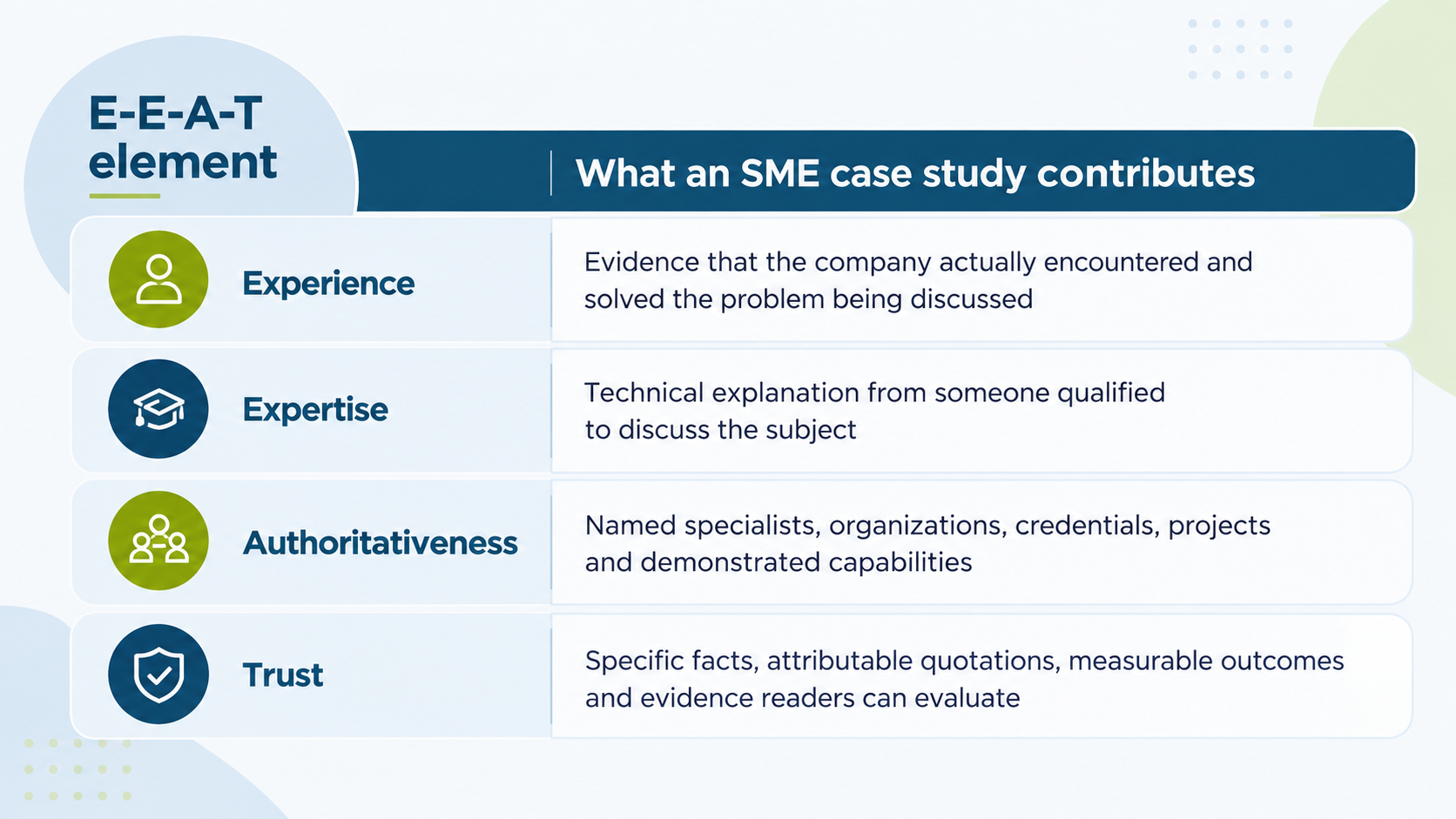
Unlike landing pages, brochures, marketing posts and your average blog, case studies that include substantive quotations from a subject matter expert rank among the strongest forms of high-value, high-trust web content. That’s providing, of course, that the case study contains evidence and insight rather than motherhood statements and general claims.
“We were very pleased with the results.” ~ Sean Smith, Dir. Research, ABC Co.
That’s not a useful quote. Try this one:
“We were very pleased with the results, as EMQ100 fans turning at 900 rpm consumed 17% less electricity on average than the EMQ50 fans that they replaced.” ~ Sean Smith, Dir. Research, ABC Co.
Even better:
“We were very pleased with the results achieved at the XYZ Co. Baltimore plant trial in July 2026, as EMQ100 fans turning at 900 rpm consumed 17% less electricity on average than the EMQ50 fans and 26.5% less at 1,700 rpm. The new blade design and lighter metal made the difference.” ~ Sean Smith, Dir. Research, ABC Co.
This is really useful from an SEO perspective, as well as for humans reading the post. Let’s break down the trust signals:
- First-hand experience: The case study documents something that actually happened.
- Expertise: A qualified SME explains what specifically happened and what was learned.
- Specificity: Names, places, numbers, timelines, and outcomes mark the content as authentic rather than generic.
- Original information: Interviews produce observations that don’t exist elsewhere online.
- Attribution: Direct quotations connect claims to identifiable people.
- Evidence: Before/after statistical data, measurements, as well as any photographs, technical details, or documented outcomes would add even more strength to the case.
Build exceptionally strong case studies
The standard case study combines Situation + Problem + Solution + Results. As long as you have an SME giving detailed quotations, this is good. That’s a strong case study. It will produce search results as well as winning over prospects (the ultimate goal!).
But the most valuable case study version goes a step further. It layers in customer experience + SME interpretation + objective evidence.
For example, rather than simply stating that a building-automation upgrade reduced energy consumption, your case study could establish the original problem, identify the system changes, provide measured results, and then quote the engineer or other expert explaining why those changes produced the improvement.
That creates several layers of credibility: What happened → evidence that it happened → expert explanation of why it happened → practical lesson for the reader.
The catch is that to get all these benefits, you need to identify your SME by name, role and relevant expertise. And get quotations that contribute actual knowledge and not just emotion or satisfaction.
Want content that garners real search results and also convinces readers that what you do is truly great?
Find a subject matter expert. Compose a well-thought-out list of questions. Conduct an in-depth interview. Then write up the case study, with or without AI help. Keep it tight, stick to the facts. There. Now you have exceptionally powerful marketing content. Really good as a sales aid, too.